

Earlier Action on Denial Risks Drives Stronger Payment Outcomes at Memorial Hospital at Gulfport
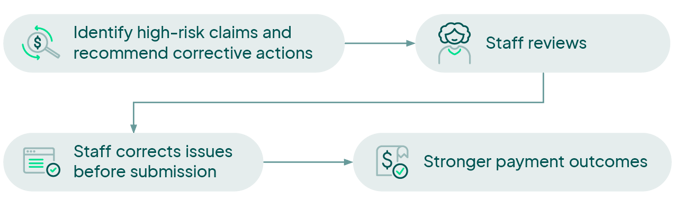
For Memorial Hospital at Gulfport, moving denial prevention upstream meant giving staff predictive visibility alongside existing claims edits. FinThrive Denials Prevention Manager flagged potential issues before submission. The hospital shifted coding-related work from back-end denial follow-up to the coding department, where staff adapted their workflows to address flagged issues earlier.
The available payer outcomes showed stronger payment results among corrected claims. Of corrected claims with explanations of benefits (EOBs), 85.1% received payment. Corrected claims also had a 77.8% lower denied-dollar share than not-corrected claims with EOBs. These findings complemented the team’s shift toward addressing predicted issues before claims reached the payer.
For Memorial Hospital at Gulfport, the partnership made predictive insights an actionable part of the coding team’s day-to-day work. Staff had both visibility into potential denial risks and a workflow for addressing them before submission—giving the hospital a concrete way to put its denial prevention strategy into practice and support its reimbursement goals.
Applying Predictive Denial Insights Before Claims Submission

4,600+
Employees
800
Medical staff members
481
Beds
$790M+
Net patient revenue

“Predictive denial analytics help us strengthen prebill claim edits and significantly reduce what the revenue cycle back end has to address. With FinThrive Denials Prevention Manager, we can use insights from payer remittance data to help prevent denials from the start, improving first-pass yield and avoiding the review and rebill effort on the back end.”
Wade B Wright, Vice President of Revenue Cycle Services, Memorial Hospital at Gulfport