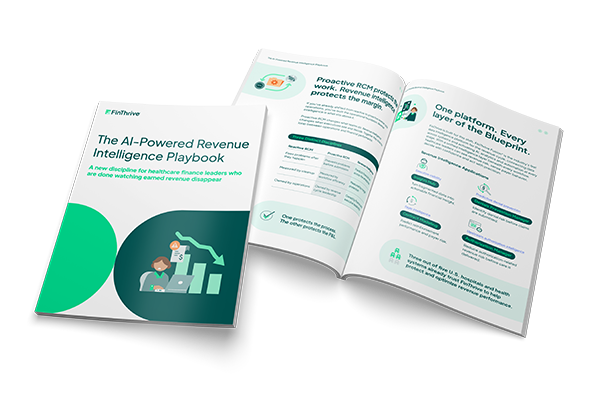

Infographic
Why Claim Denials Are Getting More Fragmented, Faster and Harder to Catch
Claim denials aren't just rising. They're changing shape. Smaller claims are getting flagged. Decisions are hitting in seconds. And more revenue is slipping through underpayments and downgrades that never look like denials at all.
Here's what's really happening and what leading hospitals are doing about it.
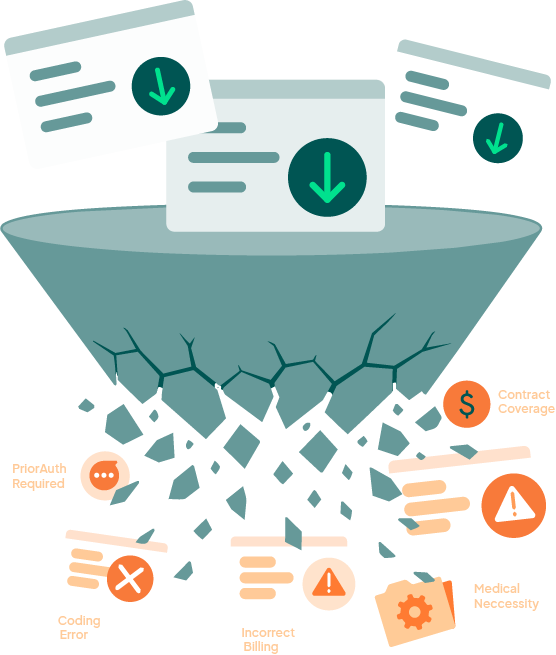

Denials Are Spreading Across More Claims
Denials used to focus on six-figure claims. Now they're touching claims of every size.

The mid-dollar and low-dollar claims providers assume are safe are where margin is quietly slipping.

Denials Are Getting Faster
AI is now driving faster claim decisions on both sides of the transaction.
Hospitals relying on manual review and status reports can't move fast enough to prevent revenue leakage or appeal in time.

Denials Are Getting Harder To Catch
The revenue you're losing may not look like a denial at all.
- DRG downgrades that never come back as denials
- Emergency department underpayments buried in remittance data
- Medical necessity decisions that show up as noncovered or investigational
- Authorizations approved on the front end and denied on the back end
- Rising audit volumes on claims providers thought were safe
Underpayments, downgrades and delays are now the quiet drains that never trigger a work queue.
Why It Matters
Hospitals recently lost more than $48 billion in earned revenue to denials and uncollected patient balances, a 25% year over year jump
Most of that revenue was legally earned. It just never arrived. That's not a workflow problem. It's a decision problem. And it's the reason reimbursement intelligence is fast becoming a strategic priority for CFOs and revenue cycle leaders.

Proof in Practice
Leading hospitals aren't waiting for the next denial cycle. They're already protecting margin with reimbursement intelligence built on FinThrive Fusion®.
$4.8M
Annualized value delivered
at Summit Healthcare with $6.7M to $11M in expected 3-year ROI
2.5%
Overall denial rate Reduction
at Phoebe Putney Health System, cutting the no-pay rate in half

Underpayments, downgrades and delays are now the quiet drains that never trigger a work queue.
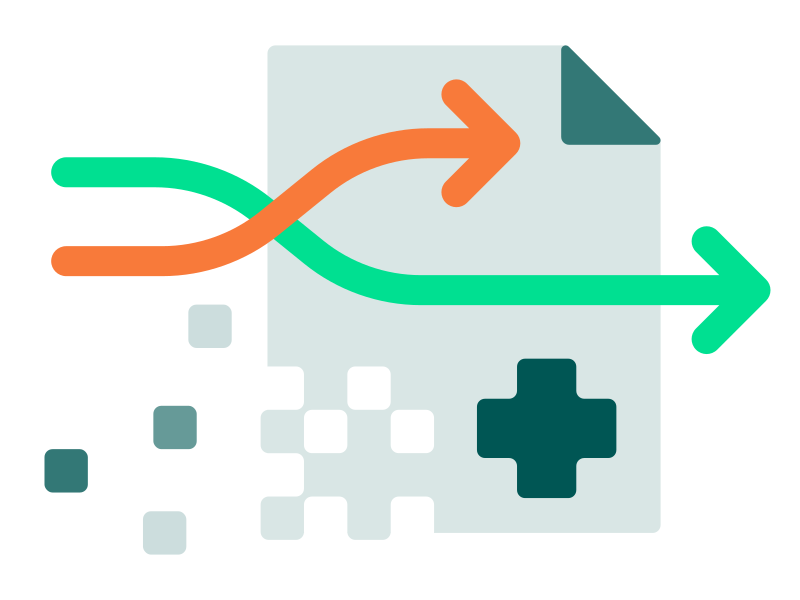
The Counter-Strategy
Reimbursement Intelligence
Reimbursement intelligence uses AI to expose behavior patterns in real time. It doesn't just react to denials. It predicts them, prevents them and defends earned revenue as reimbursement dynamics shift.

The Bottom Line
You can't outwork today's reimbursement reality.
You have to outsmart it.
That starts with seeing behavior patterns clearly and acting on them before revenue is at risk.
Go deeper on the strategy.
The AI-Powered Revenue Intelligence Playbook shows CFOs, CROs and VPs of Revenue Cycle how to turn reimbursement patterns into margin protection using a four-layer AI framework.