

Key Takeaways
-
The proposed cut is about 37% compared with current payment. CMS would pay for certain separately payable 340B-acquired drugs at ASP minus 33.4% starting January 1, 2027, down from ASP plus 6%. On a $100 ASP drug, that's $106 versus $66.60.
-
The offset won't help every hospital. CMS would raise non-drug OPPS payments by about 8.44% for OPPS hospitals under the proposed budget-neutrality adjustment, and it expects the drug cuts to outweigh that increase for most 340B providers.
-
The claim is where revenue cycle teams feel it first. CMS currently requires TB on 340B-acquired separately payable Part B drug claims. If finalized, the 2027 proposal would bring JG back for non-exempt hospitals, keep TB for exempt entities and require a new modifier for non-340B drugs.
-
Payers decide whether to follow Medicare. Medicare Advantage plans and commercial payers apply their own contract terms, so checking that payments match matters.
-
Not every hospital is affected. Rural sole community hospitals, children's hospitals and PPS-exempt cancer hospitals would be exempt, while critical access hospitals, rural emergency hospitals and Maryland waiver hospitals are outside the OPPS payment methodology.
TLDR
CMS has proposed cutting Medicare payment for certain separately payable 340B-acquired drugs by about 37% compared with current ASP plus 6% payment starting in 2027. The rate is a pharmacy and finance issue, but revenue cycle teams feel it in three places: the modifiers on the claim, whether payers pay the right amount and how early leaders can see their exposure. Nothing's final yet, which gives teams time to model exposure and test billing edits before January 1.
Why 340B Matters to Revenue Cycle Leaders
340B is a pharmacy, finance and compliance program, and FinThrive isn't a 340B program vendor. But a payment cut this size doesn't stay in the pharmacy. It changes what goes on a claim, raises questions about what payers owe and makes it harder to see where revenue stands. This post sticks to what CMS proposed and where it reaches revenue cycle management.
What Is CMS Proposing for 340B Drug Payment in 2027?
The 340B program lets eligible covered entities buy covered outpatient drugs at a discount, and it's grown fast. HRSA says it went from $53.7 billion in 2022 to more than $100 billion in 2025. In the CY 2027 Hospital Outpatient Prospective Payment System (OPPS) proposed rule, CMS would pay for certain separately payable 340B-acquired drugs, biologicals, biosimilars and radiopharmaceuticals at average sales price (ASP) minus 33.4% starting January 1, 2027. It built the proposed rate on a hospital drug acquisition cost survey, the step the Supreme Court said was missing when it struck down an earlier ASP minus 22.5% cut in 2022 (Husch Blackwell).
The proposed budget-neutrality increase would be spread across OPPS hospitals rather than targeted only to hospitals with high 340B drug volume (Advisory Board). CMS wrote that it expects the drug cuts to outweigh the non-drug increase for most 340B providers. KFF's analysis of CMS projections, reported by Fierce Healthcare, shows disproportionate share hospitals with a net 5.8% reduction in OPPS revenue, while for-profit hospitals would see a net increase.
Rural sole community hospitals, children's hospitals and PPS-exempt cancer hospitals would be exempt. So would vaccines, drugs with transitional pass-through status and non-opioid pain management drugs (Bass, Berry & Sims). Critical access hospitals and rural emergency hospitals aren't paid under OPPS, and Maryland waiver hospitals are outside the OPPS payment methodology, so the proposed OPPS rate change doesn't apply to them in the same way. And nothing is final. CMS also asked for comment on an alternative rate of about ASP minus 28%, based on HRSA ceiling price data (Phelps).
What Changes on the Claim?
The policy runs on modifiers. CMS currently requires 340B covered entities to report the TB modifier on 340B-acquired separately payable Part B drug claims since January 1, 2025. Before that, many reported JG. If finalized, the 2027 proposal would split the two again. Non-exempt hospitals would report JG for affected 340B-acquired drugs, and it would trigger the lower rate. Exempt hospitals and other covered entities not paid under OPPS would keep reporting TB, which doesn't change payment. CMS would also require a new modifier on separately payable drugs not acquired through 340B (the proposal uses XX as a placeholder).
Because the modifier decides which rate applies, a missing or wrong one puts the claim on the wrong rate. If the rule is finalized as proposed, billing systems and edits need to be ready by January 1.
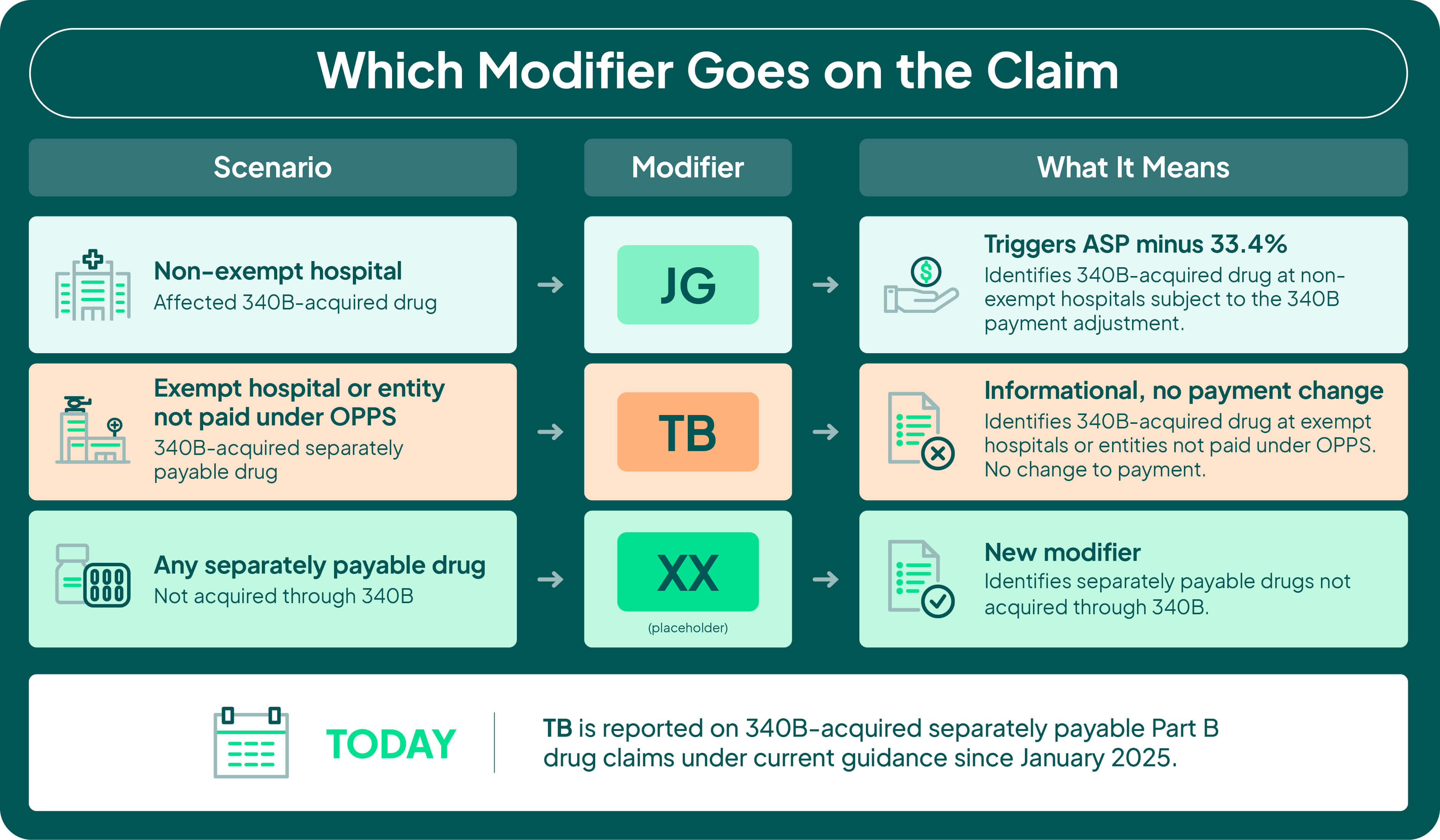
Proposed modifier requirements starting January 1, 2027, if finalized as proposed.
How Do 340B Payment Changes Reach Revenue Cycle Management?
Revenue cycle teams can't change the rate, decide eligibility or run the 340B program. Those sit with pharmacy, finance and compliance. They do own three things this proposal touches: what goes on the claim, whether payers pay what they owe and how early leaders can see the effect.
The payer question deserves a closer look. Medicare Advantage plans and commercial payers don't automatically have to mirror every CMS OPPS policy unless their contracts or payment methodologies make them do so. Ensemble Health Partners reports that Medicare Advantage rates are often tied to or influenced by Original Medicare rates, depending on contract terms and plan methodology, and that MA plans followed CMS when it cut the 340B rate in 2018 and when it restored it in 2022. They didn't follow CMS on a remedy for the earlier underpayments. Advisory Board presumes most MA plans will follow this proposal over time, while commercial payments stay a matter of contract terms.
If a contract pays a percentage of Medicare, check how it treats both changes: the drop on 340B drugs and the increase on non-drug services. Terms vary, so this is a contract-by-contract question.
The specifics of the proposed rule may continue to evolve, but the revenue cycle priorities are already clear: understand your exposure, validate billing workflows and confirm that payer reimbursement aligns with contract terms.
Where FinThrive Fits
FinThrive doesn't set 340B policy, and we don't replace your 340B program or your pharmacy team's compliance work. We can help with the part that sits in revenue cycle management: checking that payers pay what their contracts say and seeing where payments fall short.
FinThrive Contract Modeling compares expected reimbursement with actual payment at the line level, so you can see where a payer's payment doesn't match its contract. FinThrive Contract Manager flags those variances and gives teams shared worklists for contract, denial and underpayment work.
The FinThrive Denials and Underpayments Analyzer shows denials and underpayments in one view, with root causes, so leaders can see where revenue is slipping and why.
Powered by FinThrive Fusion®, our connected data intelligence engine, these solutions work alongside the EHR and revenue cycle tools you already have. See how we work with hospitals and health systems.
What Healthcare Leaders Can Do Now
-
Model your exposure. Pull your own Part B drug claims and look at drug, payer and site of care. Model the proposed 340B drug payment change, the proposed non-drug OPPS budget-neutrality increase and the separate ongoing 340B remedy offset as distinct assumptions.
-
Test your billing edits. Confirm who owns modifier assignment and that your edits handle JG, TB and the new non-340B modifier before January 1.
-
Review your payer contracts. Check how each one treats a change in Medicare rates, and watch for payments that don't match.
The Bottom Line
340B payment rules are still moving, but the revenue cycle work is already clear: get the modifiers right, check that payers pay what they should and know your own exposure. We'll update this post when CMS publishes the final rule.
See where payer payments fall short of your contracts. Talk to a FinThrive expert.

About the Author
Brandon Burnett is Chief RCM Officer at FinThrive, where he translates frontline revenue cycle challenges into strategy, product direction and market impact. He brings more than 23 years of experience leading end-to-end revenue cycle operations, most recently as VP of Revenue Cycle at Community Medical Centers and previously across 13 years at Kaiser Permanente.

Frequently Asked Questions
What is CMS proposing for 340B drug payment in 2027?
CMS has proposed paying for certain separately payable 340B-acquired drugs at average sales price (ASP) minus 33.4% starting January 1, 2027, down from ASP plus 6%. On a drug with a $100 ASP, payment would fall from $106 to $66.60, about 37% compared with current payment. The proposal is part of the CY 2027 OPPS proposed rule.
Will the offsetting increase make up for lost 340B drug revenue?
Not for most 340B providers, according to CMS. To stay budget neutral, CMS would raise non-drug OPPS payments by about 8.44% for OPPS hospitals under the proposal, and it wrote that it expects the drug cuts to outweigh that increase for most 340B providers. Your result depends on your drug mix, so model it from your own claims.
Which hospitals and drugs are exempt from the proposed 340B payment cut?
Rural sole community hospitals, children's hospitals and PPS-exempt cancer hospitals would be exempt. So would vaccines, drugs with transitional pass-through status and non-opioid pain management drugs. Critical access hospitals, rural emergency hospitals and Maryland waiver hospitals are outside the OPPS payment methodology, so the proposed OPPS rate change doesn't apply to them in the same way.
What is the JG modifier for 340B drugs, and is it coming back?
Under the proposal, non-exempt 340B hospitals would report JG again for affected 340B-acquired drugs, and it would trigger the lower rate. Exempt hospitals and covered entities not paid under OPPS would keep reporting TB, which doesn't change payment. CMS would also require a new modifier on separately payable drugs not acquired through 340B.
How do 340B payment changes reach revenue cycle management?
In three places. The modifiers on the claim decide which rate applies. Payers decide whether to follow Medicare's rate, so contracts and payment accuracy matter. And the net effect varies by drug mix, so leaders need a model built from their own claims. Rate-setting and eligibility stay with pharmacy and finance teams.
Is the proposed 340B payment cut final?
No. The policy takes effect January 1, 2027 only if CMS finalizes it. CMS also asked for input on an alternative rate of about ASP minus 28%, based on HRSA ceiling price data, and some analysts expect legal challenges. Model your exposure now and update it when the final rule publishes.
How can hospitals prepare for 340B payment changes?
Model exposure by drug, payer and site of care from your own claims. Test billing edits for the modifiers before January 1. Check how your payer contracts treat the change and whether payments match. FinThrive supports the contract and underpayment pieces. We don't set or replace your 340B program or its compliance work.