

Key Takeaways
- Cost to collect is climbing across the industry. HFMA's best-practice benchmark sits at or below 2% of net patient revenue, but many hospitals and health systems still run well above it, and the gap is real money.
- Claim adjudication costs are a major driver. The average cost to adjudicate a single denied claim rose from $43.84 to $57.23 in one year, and most of that spend goes toward claims that get overturned and paid anyway.
- Vendor sprawl keeps cost to collect high. Nearly 70% of provider organizations want to reduce their RCM vendor count, and consolidation is becoming as important a lever as automation.
- AI is closing the gap fast. Well-deployed agentic AI in the revenue cycle can cut cost to collect by 30 to 60%, and most health systems are already deploying or piloting it.
- This isn't just a large health system issue. Community and rural hospitals often carry the same vendor sprawl and denial exposure with far less staff to manage it.
TLDR
Cost to collect keeps climbing for hospitals and health systems alike, driven by rising claim adjudication costs and sprawling, disconnected RCM vendor stacks. HFMA's best-practice benchmark is 2% of net patient revenue, but most organizations run higher, and every point above that is margin lost to rework instead of patient care. The fix isn't one tool. It's connecting the ones you already have and cutting the vendor sprawl driving the cost up in the first place.
The Hidden Cost of Revenue Cycle Complexity
I've spent more than two decades running revenue cycle operations, and I can tell you the hardest number to pin down is often the one that matters most. Ask five revenue cycle leaders what they spend to collect a dollar of earned revenue and you'll likely get five different answers. That's the trouble with cost to collect. Everyone agrees it matters, but few organizations measure it the same way, and fewer still have a clear plan to bring it down.
If you're running revenue cycle for a hospital or health system, you already know this isn't an abstract finance metric. You're managing thin margins, rising denials and a patchwork of point solutions, and every dollar you spend chasing payment is a dollar that isn't going toward patient care, staff or growth. Cost to collect is one of the clearest signals you have for how efficiently your organization turns clinical work into cash.
What Is Cost to Collect?
Cost to collect measures the total operational expense required to collect revenue a hospital or health system has already earned. HFMA defines it simply: total revenue cycle cost divided by total patient service cash collected. That includes salaries and benefits across patient access, coding, billing and denials management, plus technology, outsourced vendor fees and collection agency costs.
It's different from net collection rate, which measures how much of the contractually expected reimbursement an organization captures. Cost to collect measures something else entirely: how much it costs to get there. A hospital can post strong collections and still lose margin if the process behind them costs too much.
Why Cost to Collect Is Climbing
The cost side of this equation is genuinely getting worse. A June 2025 MGMA Stat poll found that 90% of medical group leaders reported higher year-to-date operating costs than the same point in 2024, with the average increase running about 11.1%. Staffing salaries, benefits and competitive pay adjustments topped the list of drivers, ahead of medical supplies and technology spend.
That pressure shows up claim by claim, too. A national survey of 280 hospitals and health systems found that the average administrative cost to adjudicate a single denied claim rose from $43.84 in 2022 to $57.23 in 2023, a jump of more than 30%. Total claims-adjudication spending across surveyed providers reached $25.7 billion, a 23% increase over the prior year. Roughly 70% of those initial denials were eventually overturned and paid, which means more than $17.6 billion of that spend went toward fighting claims that should have been paid the first time.
If your organization is fighting even 10,000 denied claims a year, that per-claim cost increase alone adds roughly $134,000 in avoidable adjudication expense to your books, before you even account for any growth in denial volume. Multiply that across your full claim base and it's easy to see how rework, not reimbursement, is what's driving your cost to collect higher.
The Benchmark Gap: What “Good” Actually Looks Like
HFMA's own guidance puts the best-practice benchmark for cost to collect at or below 2% of net patient revenue, a standard that has tightened from roughly 3% over the past five to seven years, driven largely by automation gains among top performers. Many hospitals and health systems still operate well above that mark, and every point above the benchmark is real money. Using HFMA's own math (total revenue cycle cost divided by cash collected), a provider organization running at 3% instead of the 2% best-practice target on $500 million in net patient revenue is spending an extra $5 million a year just to collect money it has already earned.
That's margin sitting in denials rework, redundant vendor contracts and manual processes instead of patient care, staff retention or capital investment.
Why Vendor Sprawl Keeps Cost to Collect High
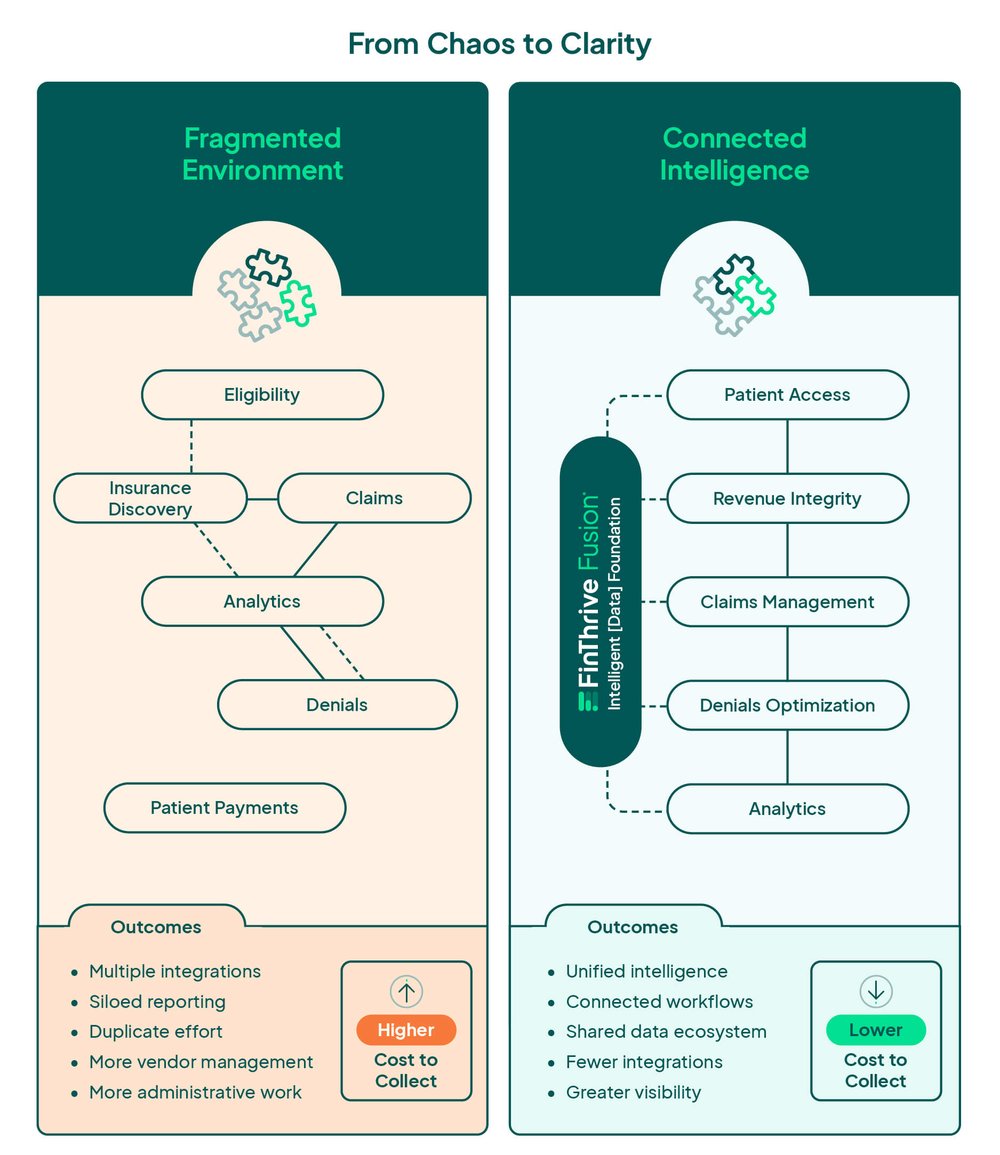
Here's where the conversation usually stalls. Most cost-to-collect content treats the metric in isolation, as a benchmarking exercise rather than a symptom of something bigger: fragmentation. Hospitals and health systems running ten, fifteen or more disconnected RCM point solutions pay for that sprawl in licensing costs, integration overhead and the labor required to reconcile data across systems that were never built to talk to each other.
The data backs this up. Nearly 70% of provider organizations say they want to reduce or rationalize the number of RCM vendors they use, according to independent market research from Black Book Research, which surveyed close to 900 provider-side respondents across hospitals, health systems and specialty provider organizations. Separately, a recent McKinsey survey covered by HealthLeaders found that half of health systems now favor modular, connected platforms over stand-alone point solutions, and 58% of underperforming health systems plan to seek new vendor relationships altogether.
That's the piece most cost-to-collect benchmarking guides miss. Knowing the number tells you where you stand. Reducing the number of vendors and systems behind that work tells you how to actually move it.
Where AI Is Moving the Needle
Automation is the other lever, and it's moving fast. McKinsey's own analysis finds that well-deployed agentic AI in the revenue cycle could cut cost to collect by 30% to 60%. HFMA's Revenue Cycle of the Future report, published in April 2026, found that 27% of health systems now run AI at scale across multiple RCM functions, with another 53% actively piloting it. Only a small minority haven't started.
That means most of the industry, hospitals and health systems alike, is already past the “should we” conversation. The real question now is where AI and consolidation intersect, since a single connected platform gives automation cleaner data to work with and fewer handoffs to break.
What This Means for Hospitals and Health Systems
Every point of cost to collect you leave untracked or unaddressed is margin you can't put toward the things that matter most: competitive staff pay, technology investment or simply staying financially resilient in a reimbursement environment that keeps getting less forgiving. And if you're running a community or rural hospital, you likely feel this even more acutely. You're often carrying the same vendor sprawl and denial exposure as a large health system, just with a fraction of the staff to manage it. Wherever your organization sits, this is a metric worth managing deliberately, not reviewing once a year.
The Hidden Cost of Revenue Cycle Fragmentation
Not all cost-to-collect challenges stem from reimbursement. Many originate from the complexity required to manage disconnected systems, workflows and vendors across the revenue cycle.
How FinThrive Helps Lower Cost to Collect
FinThrive Fusion®, our data intelligence platform, connects claims, denials, contracts and coverage data so every solution gets smarter over time instead of operating in its own silo. Denials Prevention Manager catches issues before submission. Contract Manager and A/R Optimizer make sure every dollar owed actually gets collected. And for community and rural hospitals managing 15 or more disconnected vendors, Community Advantage bundles the full revenue cycle onto one platform, so consolidation itself becomes part of the cost-to-collect solution instead of another project competing for budget.
Ready to Lower Your Cost to Collect?
Lowering your cost to collect isn't about one fix. It's about connecting the ones you already have, no matter the size or structure of your organization.
Explore FinThrive's outcomes to see the results hospitals and health systems of every size are seeing across denials prevention, yield and cost to collect. And if you're a community or rural hospital managing a large stack of disconnected vendors, see how Community Advantage brings your revenue cycle onto one platform built specifically for organizations your size.

About the Author
Brandon Burnett is Chief Revenue Cycle Officer at FinThrive, where he translates frontline revenue cycle challenges into strategy, product direction and market impact. He brings more than 23 years of experience leading end-to-end revenue cycle operations, most recently as VP of Revenue Cycle at Community Medical Centers and previously across 13 years at Kaiser Permanente. He works closely with CFOs and revenue cycle leaders on automation, platform consolidation and lowering cost to collect.

FAQs
A quick reference from FinThrive on the questions healthcare finance leaders ask most about cost to collect.
What is cost to collect in healthcare?
Cost to collect is the total expense a hospital or health system incurs to collect the revenue it has already earned, including labor, technology, rework and vendor fees, expressed as a percentage of net patient revenue or cash collected.
What's a good cost-to-collect benchmark?
HFMA's best-practice benchmark is at or below 2% of net patient revenue, down from roughly 3% five to seven years ago. Many hospitals and health systems still run above that mark, which means real room to improve for most provider organizations.
How does vendor consolidation lower cost to collect?
Fewer disconnected RCM vendors mean less licensing overhead, fewer integration gaps and less manual reconciliation work. Recent research shows nearly 70% of provider organizations want to reduce their vendor count, and more than half now favor connected, modular platforms over stand-alone point solutions.
How much can AI reduce cost to collect?
Industry analysis from McKinsey suggests well-deployed agentic AI in revenue cycle management can reduce cost to collect by 30% to 60%, primarily by preventing denials and cutting manual rework before it starts.