


Denials prevention has rightfully taken center stage in the revenue cycle conversation, and for good reason. Stopping a denial before it happens is one of the highest-impact moves a health system can make. But there’s a companion problem that often gets less attention and quietly chips away at margin in parallel, and it’s costing hospitals millions in revenue they’ve already earned.
That problem is the money you’ve billed, “collected” and closed out. Yet it never fully landed in your bank account. Denials are visible. Underpayments aren’t. The strongest revenue cycle leaders are tackling both as two sides of the same payment integrity strategy.
Denials Get the Spotlight. Underpayments Deserve It Too.
Most revenue cycle conversations today focus on denials, AR days and patient collections, and they should. Preventing denials upstream is one of the most measurable wins available to health systems right now, with proven ROI across every payer category. But while leaders rightfully invest in denials prevention, a parallel problem keeps growing in the background and rarely shows up on the same dashboard.
Hospitals lost more than $48 billion in net revenue in 2025, up from $38.6 billion in 2024, a 25% year-over-year increase. Denials are a major driver, but they’re not the only one. Underpayments, contractual variances and silent erosion inside accounts your team’s already closed are all part of the same leakage story. Those closed accounts have a name, and they’re called zero-balance accounts.
What’s a Zero-Balance Account?
A zero-balance account is any claim where the balance has been reduced to $0 after both insurance and the patient have paid. From a workflow standpoint, it looks finished, the payer’s remitted, the system shows nothing owed and the account moves out of active worklists. But finished isn’t the same as fully paid.
Many of these accounts contain unrecovered underpayments, contractual variances and missed reimbursement hospitals never identify, and the cumulative impact’s significant. For a $1B health system, that can mean tens of millions of dollars of recoverable revenue sitting in plain sight, often hidden behind the appearance of a closed claim.
Why Zero-Balance Accounts Are Often Overlooked
Three structural forces are quietly creating this gap.
1. Payer Behavior’s Increasingly Variable
Both initial and final claim denials are highly variable by payer category, with commercial denials contributing the most to revenue leakage because commercial plans pay higher rates. Medicare Advantage initial and final denial rates were more than double the rates for traditional Medicare, adding another layer of complexity to an already fragmented payer landscape.
That variability extends to what payers actually pay on accepted claims, not just what they deny. Medicare and Medicaid underpaid hospitals by $130 billion in 2023 alone, with shortfalls growing 14% annually since 2019, and Medicare Advantage reimbursement to hospitals fell 8.8% on a cost basis between 2019 and 2024. When payers shift quietly, hospitals don’t always know they were underpaid.
2. Underpayments Are the Hidden Half of the Equation
Denials prevention’s a critical priority, and the gains are real. But acceptance doesn’t always mean a claim is fully protected. Denials can still surface after a claim has been accepted, while underpayments are most dangerous at payment, when the payer reimburses less than expected and the account can quietly close as if nothing’s wrong. That means even your cleanest claims can leave money on the table without anyone noticing.
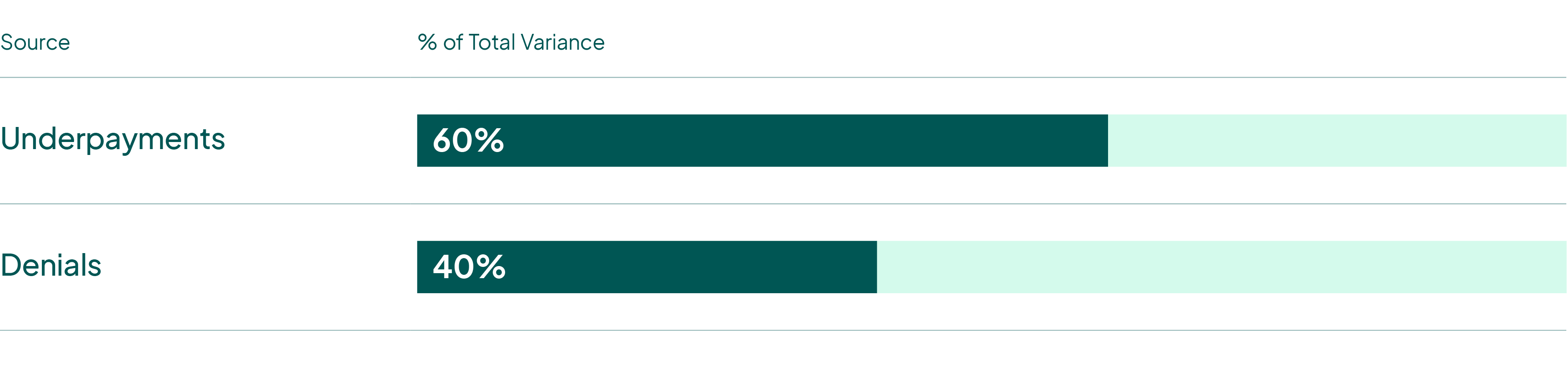
A FinThrive customer analysis of one health system uncovered $34 million in contractual payment discrepancies over five years, with 60% of that variance coming from underpayments and 40% from denied claims. That’s the case for treating them together as part of one integrated discipline. Strong denials prevention protects the front door, while underpayment recovery protects what gets paid on the back end.
Two Sides of the Same Coin
Source of $34M five-year payment discrepancy at one health system
Examples teams routinely miss in the underpayment category include ED level downgrades, rate effective date misapplications, DRG underweighting, contract amendment lag and CMS guideline misinterpretation. A single $500 underpayment’s forgettable on its own, but across thousands of claims, the dollars add up fast and quietly compound into a meaningful margin issue.
3. Hospitals Are Drowning in Administrative Cost
Labor accounted for 56% of total hospital costs in 2024, and margins remain thin while operational teams are stretched. When teams are stretched, the lowest-priority work is the work that looks finished, and that’s exactly where zero-balance leakage lives.
Why Traditional Revenue Cycle Tools Miss This
Most denials management and AR tools are designed to surface what’s open, and they’re essential for denials prevention and active recovery. The challenge is that zero-balance accounts are closed, so they don’t appear in worklists, trigger alerts, show up in standard denial dashboards or get prioritized in AR follow-up.
Here’s the catch. The more efficient your team becomes at clearing accounts, the more invisible your underpayments may become, which is why denials prevention and payment integrity belong on the same scorecard rather than operating as separate workflows.
What Best-in-Class Organizations Are Doing Differently
The leaders quietly outperforming their peers are pairing strong denials prevention with continuous payment integrity. Same strategy. Two complementary disciplines.
They run continuous variance reviews.
Top-performing organizations aren’t waiting for annual or quarterly audits to find underpayments. They build continuous variance monitoring into the revenue cycle as a safety net, using internal teams, vendor support or a combination of both to look back across closed accounts and catch what routine billing workflows may miss. That added layer helps surface issues in real time rather than months after the fact.
They model every contracted payer.
Limiting reviews to the top three payers leaves significant recoverable revenue on the table. Underpayment patterns usually surface only when expected reimbursement’s modeled across the full payer book, including the smaller plans that quietly underpay.
They use data to drive front-end change.
Every recovered underpayment’s a clue to a bigger issue, and the patterns reveal contract terms being misapplied, payer policy shifts, coding logic gaps, system configuration issues and potential breakdowns in admitting or registration workflows. Understanding the reimbursement nuances between commercial, Medicare and Medicaid is critically important when assigning the correct coverage at the point of service. That intelligence feeds directly back into denials prevention upstream and helps teams prevent the same issues from recurring.
They measure variance, not just collections.
Cost-to-collect matters, but it doesn’t tell the whole story. The better question is whether the organization actually collected what it expected to collect after contractual adjustments and write-offs. That’s where net collection ratio (NCR) becomes a stronger signal. If zero-balance accounts aren’t part of the review process, even NCR can look healthier than it really is because underpayments, payer variances, billing errors and denial-related leakage may be sitting inside accounts that appear fully resolved.
The Financial Impact: Why This Is a CFO-Level Issue and Top Priority for Executives to Fix
Denials prevention and payment integrity are both margin protection strategies, and together they form a complete view of recoverable revenue. The numbers tell the story:
-
Hospitals absorbed $130B in Medicare and Medicaid underpayments in 2023, growing 14% annually
-
Medicare Advantage hospital reimbursement fell 8.8% on a cost basis between 2019 and 2024
-
In one health system, 60% of contractual variance came from underpayments and 40% from denials
When margins are razor-thin, every recovered dollar’s a margin dollar, and CFOs can’t afford to let one half of the leakage problem go unaddressed.
How FinThrive Helps You Prevent Denials and Recover Hidden Revenue
Protecting revenue takes more than a one-time audit. It takes connected data, contract intelligence and workflows that prevent denials upstream and surface what other systems miss downstream. That’s exactly how FinThrive built its approach to payment integrity.
Instead of treating denials, underpayments and contract variances as separate problems, FinThrive unifies them on a single platform powered by FinThrive Fusion®, an RCM data intelligence platform that connects claims, contracts, remittances and payer behavior in real time. Here’s how it comes together.

Contract Manager
Calculates what every payer should pay you, line by line, across all contracted plans. FinThrive customers see 98%+ contract pricing accuracy and a 50% reduction in payment discrepancies, turning contract terms into measurable defensible revenue. One health system used Contract Manager to uncover $34M in contractual payment discrepancies over five years, with 60% from underpayments and 40% from denied claims.

Denials and Underpayments Analyzer
Surfaces denials and underpayments in one unified view with line-level visibility into root causes. It’s purpose-built to prevent denials upstream and detect what zero-balance reviews typically miss, including downgrades, rate effective date errors and contract misapplications. More than 32% of medical claims were underpaid, totaling over $5 billion in uncollected reimbursements, with recoveries improving by up to 20% over traditional methods.

A/R Optimizer
Prioritizes the right accounts using expected reimbursement logic, so teams stop chasing low-value rework and start recovering high-impact dollars first. It scales recovery through bulk appeals, intelligent prioritization and seamless integration with patient accounting systems, which means recovery teams can do more without adding headcount.

FinThrive Analyze
Gives finance and revenue cycle leaders a single source of truth for variance, denial trends and payer behavior. Insights from recovery work feed back into prevention upstream, closing the loop between what’s been lost and what can be stopped.
The Bigger Idea: End-to-End Payment Integrity
Strong denials prevention stops revenue loss at the source, and payment integrity protects what gets paid. FinThrive delivers both as part of one connected strategy. Together, Contract Manager + Denials and Underpayments Analyzer + A/R Optimizer form FinThrive’s end-to-end payment integrity solution, giving health systems the power to validate, recover and protect every earned dollar.
The result is fewer denials at the front end, faster recovery of underpayments at the back end, cleaner data feeding back into prevention and lower cost to collect across the revenue cycle. You don’t just prevent the leak. You also stop the one already happening.
Common Questions About Zero-Balance Accounts
Q: What’s payment variance in healthcare?
Payment variance is the difference between what a payer was contractually obligated to pay and what they actually paid. It includes underpayments, downgrades and missed contractual adjustments, and it’s one of the most common sources of hidden revenue leakage in hospital revenue cycles.
Q: What’s the difference between a denial and an underpayment?
A denial is a payer’s refusal to pay all or part of a claim, while an underpayment’s when a payer accepts a claim but reimburses less than the contracted rate. Denials are visible and tracked, while underpayments are often hidden inside zero-balance accounts. Both impact margin and both deserve focus as part of an integrated payment integrity strategy.
Q: How much revenue can hospitals recover through variance reviews?
In one FinThrive customer analysis, 60% of a $34M five-year payment discrepancy came from underpayments and 40% from denials, surfacing millions in recoverable revenue traditional denial-only reviews never caught. Recovery potential varies by organization, but most health systems find meaningful dollars hidden in closed accounts.
Q: Why don’t denial management systems catch underpayments?
Most denial systems focus on open balances, which is exactly what denials prevention requires. Zero-balance accounts are categorized as resolved, so they fall outside standard worklists and require a complementary payment integrity workflow built specifically for closed-account variance review.
Q: How often should variance reviews happen?
Leading organizations conduct continuous reviews rather than periodic audits, using safety net lookbacks to catch what routine billing workflows may miss after an account closes. That added layer helps them capture payer policy shifts in real time and prevent small variances from compounding into significant losses.
The Bottom Line
The next wave of revenue cycle performance won’t come from doing the same work faster. It’ll come from pairing strong denials prevention with continuous payment integrity, where one protects the front door and the other protects what gets paid.
As payer behavior grows more variable and margins stay tight, the organizations that win will treat both as a single connected discipline rather than a one-time audit. The denials you fight are visible and the dollars you miss aren’t, but both belong on the same scorecard if you want a complete view of your revenue.
See What’s Hiding in Your Closed Accounts
Most health systems don’t realize how much revenue’s sitting inside accounts they’ve already written off. FinThrive’s payment integrity solutions can help you prevent denials, recover underpayments and protect every earned dollar.