

Jan 13, 2026
- 76% of RCM leaders cite automation solutions as their #1 initiative in 2026
- Patient experience, the top organizational goal at 71%, is driving automation enhancements with 56% stating automation and AI represents their most significant area of investment.
FinThrive, Inc., a leading healthcare revenue management software-as-a-service (SaaS) provider, today released its third annual Transformative Trends and Data-Driven Insights Report, highlighting how hospitals are investing in automation, AI, and innovative vendor strategies to strengthen revenue cycle performance and enhance the patient financial experience.
The Report finds, for the first time since FinThrive began tracking revenue cycle management (RCM) leaders' goals and investment priorities through the Transformative Trends survey in 2023, that patient experience is the top organizational goal (71%), alongside increasing revenue (58%) and reducing costs (36%). Leaders aren’t choosing between experience and economics; instead, they’re increasingly relying on AI, automation, and better-integrated systems to reduce friction across the revenue cycle, deliver clearer financial communications, accelerate resolution, and ultimately support stronger collections and lower cost-to-collect.
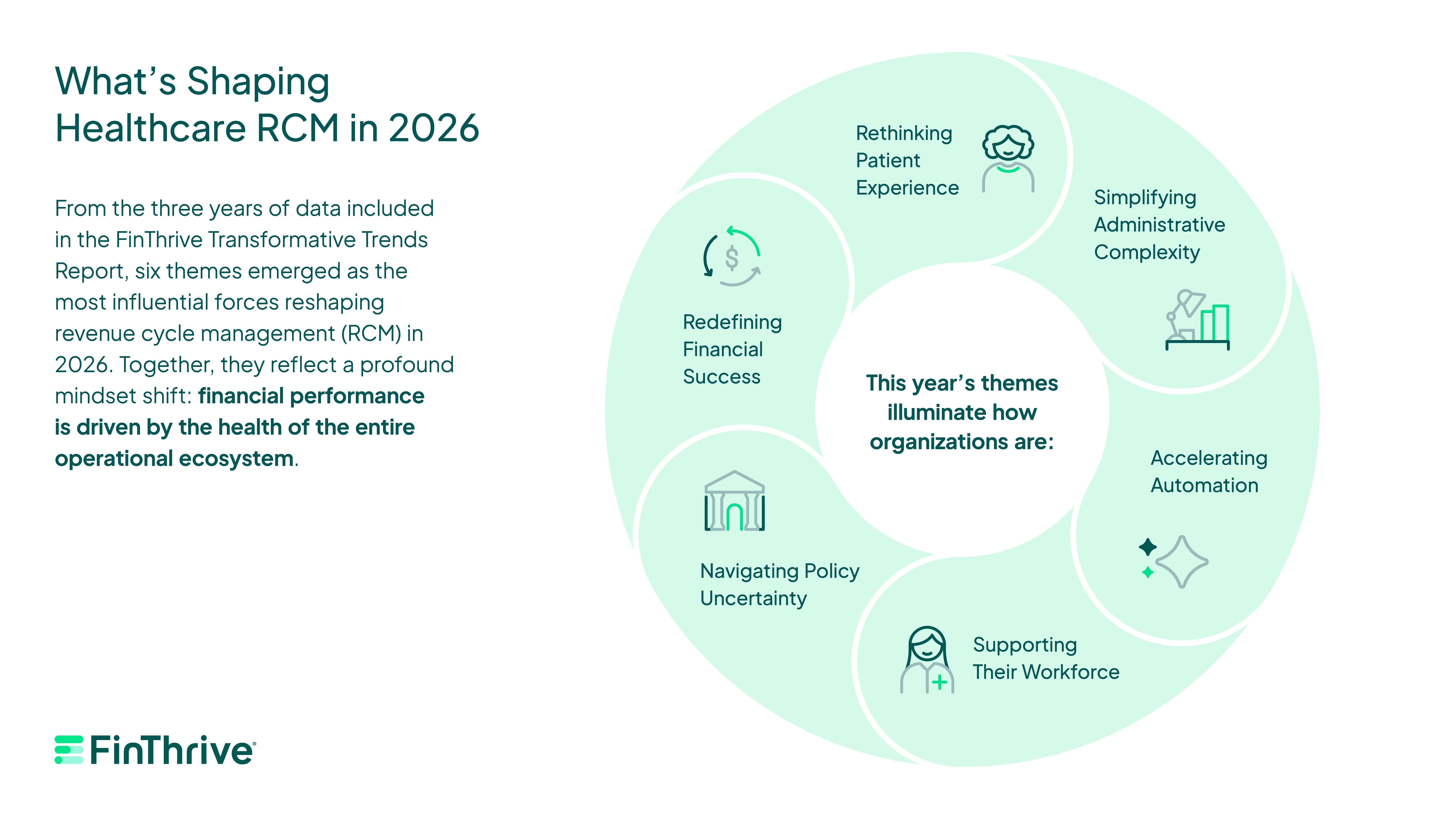
“This reordering indicates that revenue cycle leaders are starting to move away from short-term fixes, such as aggressive cost-cutting and narrow reimbursement strategies,” said Hemant Goel, President and Chief Executive Officer, FinThrive. “Organizations are shifting from reactive crisis management to deliberate recalibration focused on rebuilding stability, rethinking growth, and advancing technology's role in the revenue cycle to improve patient satisfaction.”
Even as patient experience climbs the priority list, revenue growth remains a central goal. The top performing organizations view these two priorities as interconnected: better experiences attract more patients and increase the payer mix.
“Patient experience is critical to financial health when coupled with an overall reduction of cost to collect. To best serve patients and communities, providers must deliver sustainable revenue. Patient experience and revenue improvement form the one-two punch that won’t change anytime soon,” explains Jake Collins, VP Revenue Cycle, Phoebe Putney.
Automation and Progressive Platform Consolidation Reshape Revenue Cycle Priorities
Additional findings from the Transformative Trends Report indicate that automation is shifting from isolated pilot projects to an enterprise imperative that spans both operational and patient-facing workflows. 76% cite automation solutions as a key initiative, and 56% state that automation and AI represent their most significant area of investment across all business goals.
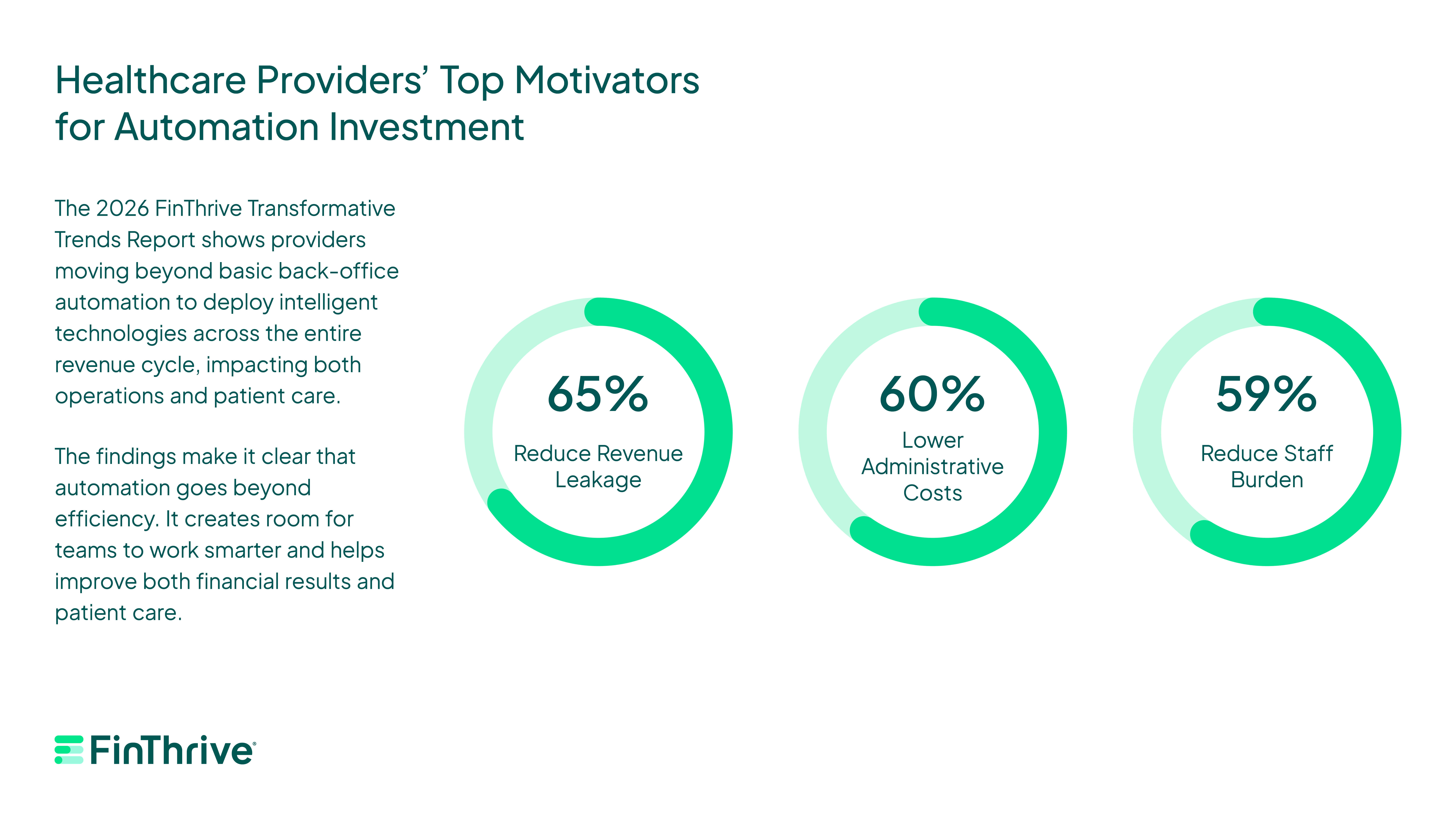
Top three areas where AI and automation are being deployed:
- Prior authorization process -- 73%
- Denials and underpayment management -- 67%
- Clinical documentation and coding -- 60%
At the same time, leaders are transitioning from fragmented point solutions to a more progressive platform consolidation approach, expanding strategically as value is realized. More than 70% of respondents expect to reduce reliance on third-party revenue cycle vendors, and nearly 60% plan to consolidate RCM vendors within the next three years—signaling providers are looking for long-term strategic partnerships with trusted vendors to support them across the platform, rather than multiple quick-fix point solutions.
Market Disruptions Accelerate Technology Adoption
Through Dec. 12, 2025, 471 healthcare-related hacking incidents were reported to the federal government, affecting more than 42 million Americans.
Forecasts for 2026 indicate a rise in cybersecurity risk as reduced federal threat-intelligence support for healthcare creates widening security gaps, driven by structural changes such as the Cybersecurity and Infrastructure Security Agency (CISA) layoffs and the Multi-State Information Sharing and Analysis Center (MS-ISAC) shift to a tiered fee-based model. For many hospitals, especially small and mid-sized systems, this amounts to an unfunded mandate that can divert funding from clinical or RCM priorities, while expanding intelligence gaps increase ransomware risk that can disrupt operations, billing, and patient safety.
To this end, the Report’s findings show that revenue cycle technology decisions have shifted from nice-to-have upgrades to core resiliency requirements. 85% of organizations report changing their strategic investment in RCM technology in response to recent cybersecurity and clearinghouse disruptions, thereby accelerating interest in platform consolidation that supports redundancy, governance, and faster recovery.
Among organizations changing their approach, 33% are shifting toward a hybrid of point solutions and platform-ready options, 25% plan to adopt a complete platform, and 22% are prioritizing point solutions with backups in critical areas such as claims and clearinghouse services—reflecting a market-wide push for both consolidation and continuity.
“Cyber and clearinghouse shocks are accelerating the next era of revenue cycle modernization,” Goel said. “The winners will be organizations that move from a siloed set of point solutions to an AI-enabled platform approach—where automation, governance, and redundancy are built in, not bolted on. That alignment compounds value through more uptime, fewer denials, faster cash, better productivity, and a simpler, more patient-friendly financial experience.”
To download the Transformative Trends and Data-Driven Insights Report, go to finthrive.com/2026-transformative-trends-report.
Methodology
Findings are based on a survey of 100 hospital financial and revenue cycle leaders across a diverse range of healthcare organizations. Independent research firm Hanover conducted fieldwork from July 18 to August 8, 2025.
About FinThrive
FinThrive is redefining revenue cycle management with innovation and intelligence at its core. Our AI-powered software unifies data and workflows to help healthcare organizations maximize revenue, reduce cost to collect, accelerate cash collections, increase workforce satisfaction and productivity and maintain regulatory compliance. As one of the most advanced SaaS platforms in healthcare, FinThrive offers a connected, holistic approach to revenue optimization, spanning patient access, charge integrity, claims and contract management, automation, analytics, and education. Today, three out of five U.S. hospitals and health systems trust FinThrive to transform financial performance. Learn more at finthrive.com.
Media Contact
Ann Smith
FinThrive Communications Consultant
asmith@coynepr.com
201-680-9447
FAQs
Q: What is the FinThrive Transformative Trends 2025 Report?
A: It is FinThrive’s annual analysis of key objectives, initiatives and investment strategies reported by U.S. provider revenue cycle leaders. The 2025 edition focuses on patient experience, automation, staffing, payer collaboration and technology strategy.
Q: Who participated in the survey?
A: The survey includes 100 director-level, VP-level and C-suite leaders responsible for revenue cycle performance at U.S. hospitals and health systems, representing a range of net patient revenue levels and EHR platforms.
Q: When was the research conducted?
A: Fieldwork was conducted from July 18 to August 8, 2025, in partnership with independent research firm Hanover.
Q: What topics does the report cover?
A: The report covers departmental goals, key initiatives, automation and AI technology investment plans, platform and vendor strategies, and concerns related to cybersecurity, implementation and funding.
Q: What are some of the key findings in the report?
A: Key findings from the report include:
- Patient experience is now the top goal for revenue cycle departments, cited by 71% of leaders for the next 12 months, surpassing revenue growth and cost reduction.
- Automation leads investment planning: 56% plan to increase spending on AI and automation capabilities, more than any other technology area, and it remains the top initiative overall.
- Cybersecurity has changed the RCM tech playbook: 85% say they are shifting strategic investment in revenue cycle technology in response to recent cybersecurity and clearinghouse disruptions.
- Progressive platform strategies are emerging: Among organizations changing their approach, one-third are moving toward a progressive hybrid of point solutions and a platform, while one-quarter plan to adopt a complete platform model.
Q: How can I access the full report?
A: The full FinThrive Transformative Trends 2025 Report is available for download at finthrive.com/2026-transformative-trends-report.