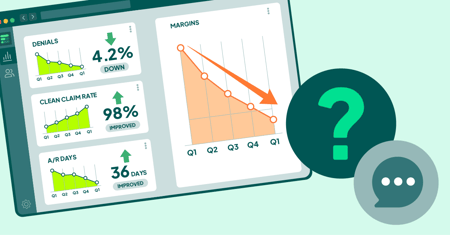


Healthcare CFOs must master financial metrics like Net Patient Revenue, Operating Margin and Accounts Receivable (AR) Days to ensure organizational stability.
As costs rise and reimbursement models shift, these data points provide the insight needed to maintain profitability and competitiveness.
Why Healthcare Financial Metrics Matter
In an industry with razor-thin margins—averaging just 1.4% for U.S. hospitals—healthcare leaders cannot rely on basic revenue calculations alone. Tracking specific key performance indicators (KPIs) allows CFOs to predict challenges, uncover improvement opportunities, and align financial decisions with strategic goals.
Financial Performance Metrics for Healthcare CFOs
1. Net Patient Revenue (NPR)
Net Patient Revenue is the actual revenue collected from patient services after deducting payer discounts, charity care and bad debt.
Why It Matters: NPR is a primary indicator of financial health. Tracking it monthly helps identify cash flow trends, assess changes in payer mix and spot revenue gaps.
2. Operating Margin
Operating Margin calculates the percentage of revenue left after subtracting operating expenses.
Why It Matters: This metric determines if an organization generates enough income to sustain operations. A declining margin often signals inefficiencies that require immediate correction.
 RELATED: Mastering Healthcare RCM with Analytics
3. Days Cash on Hand
Days Cash on Hand measures the number of days an organization can continue operating using current cash reserves.
Why It Matters: Liquidity is essential for emergencies and daily expenses. A healthy benchmark for hospitals is typically around 150 days, ensuring stability and the ability to fund capital projects.
4. Accounts Receivable (AR) Days
Accounts Receivable (AR) Days represents the average time it takes to collect payment after providing services. This metric is influenced by payer processes, claim denials and billing efficiency.
Why It Matters: High AR days strain cash flow and suggest inefficiencies in billing or claim denials. CFOs should target 40–50 AR days to minimize delays.
5. Cost Per Patient Day
Cost Per Patient Day is the average expense incurred to deliver care to a patient over a 24-hour period.
Why It Matters: This metric highlights resource allocation efficiency. Tracking it helps CFOs identify overstaffing or wasteful spending without compromising care quality.
6. Payer Mix
Payer Mix breaks down revenue sources by percentage, including Medicare, Medicaid, private insurance and self-pay.
Why It Matters: Since payer demographics impact reimbursement rates, monitoring this mix allows CFOs to forecast revenue changes and negotiate better insurance contracts.
RELATED: Key Healthcare RCM KPIs for a Strong Bottom Line
7. Adjusted Revenue Per Encounter
Adjusted Revenue Per Encounter calculates revenue generated per visit or procedure, adjusted for case and payer mix.
Why It Matters: This metric helps evaluate the financial performance of specific service lines, allowing leaders to prioritize high-value areas.
8. Supply Chain Cost Ratio
The Supply Chain Cost Ratio compares supply costs against total operating expenses.
Why It Matters: Supply chain expenses can reach 30% of operating costs. Monitoring this ratio reveals waste and highlights opportunities for contract negotiations.
9. EBITDA
EBITDA (Earnings Before Interest, Taxes, Depreciation and Amortization) measures operational profitability by excluding non-operating expenses.
Why It Matters: EBITDA serves as a standard benchmark for comparing performance against industry peers and tracking long-term operational efficiency.
10. Revenue Cycle Efficiency
Revenue Cycle Efficiency evaluates how effectively services convert to revenue using metrics like clean claim rates, denial rates and billing lag times.
Why It Matters: A streamlined revenue cycle improves cash flow and reduces administrative burden. Consolidating vendors and adopting advanced technology helps lower total ownership costs and boost performance.
A streamlined revenue cycle not only improves cash flow and reduces administrative burdens but also lowers the total cost of ownership through digital transformation and tech adoption. By consolidating vendors, minimizing risks and leveraging advanced technologies, organizations can achieve greater efficiency while reducing costs. Regular monitoring ensures bottlenecks are identified and addressed, further boosting financial performance.
Conclusion
For healthcare CFOs, tracking the right financial metrics is essential to navigating the challenges of today’s complex industry.
Metrics like net patient revenue, operating margin and accounts receivable days provide critical insights into financial health, while metrics such as cost per patient day and supply chain cost ratio highlight areas for operational improvement.
By staying informed and proactive, CFOs can make data-driven decisions that enhance efficiency, improve cash flow and ensure long-term sustainability.
Want to elevate your organization's RCM analytics strategy?
Discover how our analytics platform, built on FinThrive Fusion®, unifies scattered financial data into a single, intelligent data fabric. Gain complete visibility into your revenue stream, enhance operational efficiency and improve decision-making. Connect with us today.
Frequently Asked Questions
Q: What is the most important financial metric for healthcare CFOs?
A: While all metrics are vital, Operating Margin is often considered the most critical as it directly indicates the organization's ability to cover its costs and sustain operations.
Q: How can healthcare organizations reduce AR Days?
A: Organizations can reduce AR Days by improving billing accuracy, minimizing claim denials, and streamlining the collections process through automation.
Q: Why is tracking Payer Mix important for revenue forecasting?
A: Different payers reimburse at different rates. Understanding the Payer Mix helps CFOs predict actual revenue more accurately than looking at gross charges alone.