

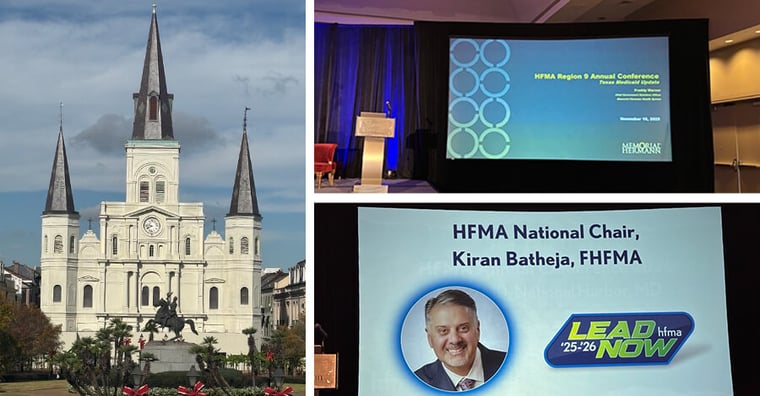
Attending the HFMA Region 9 Annual Conference this year reinforced something I’ve felt for a while. Our region is not just dealing with complex financial realities. We are experiencing early signals of where national healthcare finance is heading.
With more than 350 leaders from across Arkansas, Louisiana, Mississippi, Oklahoma, and Texas gathered in New Orleans, the conversations were candid, often sobering, and grounded in the shared urgency we all feel.
This conference has always stood out to me because Region 9 faces challenges that many other markets do not. High Medicaid and Medicare populations, heavy uninsured rates, billions in uncompensated care, and the ongoing strain on rural hospitals shape every financial decision we make. These realities influenced every session I attended.
Below are the themes that stood out most and why they matter for the road ahead.
1. Medicaid and Medicare Pressures Are Reshaping the Landscape
One of the conference’s clearest messages was that reimbursement pressure is intensifying — and Region 9 organizations will continue to feel it more acutely than most.
In one of the opening sessions, I was struck by the scale of the Medicaid challenge facing states like Texas. With a projected $750M Medicaid shortfall in 2026 and more than $10B in uncompensated care annually, the financial strain is extraordinary. Non-expansion states are making increasingly difficult decisions, and the political environment surrounding Medicaid is more charged than I’ve ever seen.
The upcoming federal restructuring under OBBBA introduces some of the biggest Medicaid changes in decades — from lower provider tax caps to eligibility tightening and work requirements. These adjustments may come gradually, but the directional impact is clear: payment pressure and operational complexity will continue rising.
Medicare isn’t offering much relief either. Inpatient Prospective Payment System (IPPS) 2026’s 2.6% increase is immediately offset by wage index challenges, especially in low-index Region 9 markets. And with 340B reform gaining momentum — including lump-sum reconciliations and a pilot rebate model launching in 2026 — hospitals will need much tighter coordination across reimbursement, finance, pharmacy, and compliance teams.
For finance executives, the takeaway is simple: the next few years require deeper modeling, more advocacy, and far closer monitoring of state-level policy than we’ve needed in the past.
2. Rural Hospitals Are Reaching a Financial Breaking Point
Another major theme was the accelerating shift toward Rural Emergency Hospital (REH) designation.
I attended a session where leaders walked through the REH model in detail — and the message was clear: many rural hospitals simply don’t have the inpatient volume or financial footing to sustain traditional operations. The REH pathway offers real lifelines: a $285K monthly facility payment, enhanced outpatient reimbursement, and some operational flexibility.
But those benefits come with meaningful tradeoffs: no acute inpatient care, staffing challenges, strict compliance requirements and the need for strong system affiliations to manage transfers. What struck me most was how many organizations are actively evaluating the model because their margins leave little room for alternatives.
3. Denials Are Becoming an AI-Driven Battlefield
Denials had a major presence across the conference agenda, and it’s no surprise why: denial write-offs have tripled since 2018, and payers are deploying some of the most aggressive automation I’ve ever seen.
In one of my favorite sessions, I saw firsthand how quickly the technology landscape is shifting.
Today:
-
1 in 10 claims is denied
-
Each denial costs an average of $184 to rework
-
Only 31% of providers are using AI in their denial strategy
-
Payers are applying generative AI to documentation requests, pattern detection, and post-payment reviews
This environment demands a different level of readiness. Traditional workflows and manual queues simply can’t absorb the volume and speed of payer-driven automation. Providers investing in predictive models, automated appeals, intelligent work queues, and more structured payer collaboration are seeing far stronger results.
RELATED: Best Practices for Collaborating With Payers
4. Medicare Advantage Growth Is Bringing New Levels of Complexity
Medicare Advantage enrollment continues to climb, but so does the complexity it brings.
What leaders are seeing now
-
Initial denial rates: 12%, up from 2.4% a decade ago
-
A/R days increased 5.2% year over year
-
Providers collect just 34.5% of patient responsibility under MA plans
-
Medical necessity denials continue rising
The compliance nuances are significant — especially around prior authorization, documentation recoupments, and the Two-Midnight Rule.
Provider organizations need stronger escalation protocols, more precise documentation practices, and tighter alignment between compliance and RCM teams.
5. Leadership Needs a Shift in Mindset in This Environment
One of the most inspiring parts of the conference for me was HFMA National Chair Kiran Betheja’s message about leadership. His LEAD NOW framework — Learn, Embrace, Aspire, Deliver, Network, Opportunity, Will You? — captured something I’ve been sensing across many organizations.
Technical excellence is important, but it isn’t enough. We need:
-
More communication across silos
-
Greater comfort with uncertainty
-
A willingness to rethink long-standing models
-
A deeper focus on workforce engagement
-
And leadership rooted in action rather than hesitation
This resonated with me because so much of the sector’s instability has pushed leaders into protective postures. What Kiran reinforced is that forward movement, clarity, and collaboration matter more than ever.
5. My Closing Takeaway: Region 9 Is a Microcosm of What’s Ahead
As the conference wrapped up, what stayed with me most was how much Region 9 reflects both the challenges and the opportunities ahead for healthcare organizations nationwide. Medicaid uncertainty, workforce strain, denial escalation, rural hospital instability and AI disruption aren’t isolated issues — they’re the shape of the industry’s future.
But I left New Orleans encouraged. The conversations were candid, the collaboration was real, and the solutions were practical. More importantly, the leaders in Region 9 showed a remarkable willingness to adapt quickly and respond decisively.
Change is unavoidable — but meaningful progress is absolutely achievable. And this year’s HFMA Region 9 conference made it clear that even in one of the country’s most complex environments, our industry has both the insight and the resolve to drive healthcare forward.
By Jonathan Wiik