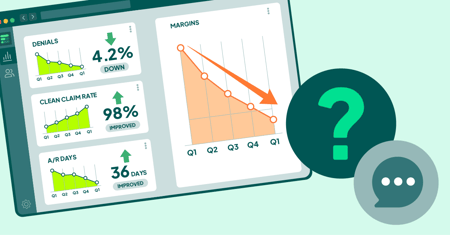


Claim denials are often treated as a reimbursement issue—something to be appealed, overturned and moved past. But for today’s hospitals and health systems, denials represent something far more consequential: a hidden and growing driver of cost to collect.
Behind every denied claim is rework, delay and administrative waste. And as payer scrutiny intensifies and labor shortages persist, denial management has become one of the clearest contributors to rising collections costs.
Smarter organizations are responding by rethinking denial management altogether—shifting from reactive recovery to proactive prevention and automation.
Denials: The CostYou Don’t See on the Claim
On the surface, denial rates can appear manageable. But the underlying math tells a different story.
- Industry benchmarks show that approximately 12% of claims are initially denied upon submission, with many providers reporting that at least one in ten claims are rejected, leading to increased rework and delayed cash flow.
- Top-performing organizations aim for a net collection rate of about 95% or higher, a key metric showing how much contractually expected reimbursement is collected after payer adjustments. Achieving this requires strong denial and underpayment management.
Each denial sets off a chain of manual activity: research, correction, appeals, payer calls and decisions about whether recovery is even worth the effort. Over time, the labor and opportunity costs can rival—or exceed—the value of the claim itself.
That’s why denials subtly increase the amount of manual work required and contribute to rising expenses in the collection process.
Why Traditional Denial Management Falls Short
Historically, denial management has lived downstream—after the claim fails. Work lists are prioritized by aging, teams chase appeals and success is measured by overturn rates.
But this approach ignores a critical reality: most denials are preventable. In fact, industry research shows that up to 86% of denials could be avoided with better processes, data and technology.
Organizations that focus only on appeals end up:
- Reworking the same issues month after month
- Missing systemic payer and workflow patterns
- Burning staff time on low-value recovery efforts
The result isn’t just lost revenue—it’s a denial process that grows more expensive every month without ever getting better.
Smarter Denial Management Starts Upstream
Leading revenue cycle teams are flipping the model by addressing denials before claims ever reach the payer.
Denial prevention begins with visibility—visibility spans patient access, coding, billing and managed care. Understanding where denials originate—by payer, reason code, department and dollar value—allows teams to separate high-frequency noise from high-impact risk.
From there, smarter denial management focuses on fixing the root causes:
- Eligibility and authorization errors caught before scheduling or service
- Documentation and coding gaps aligned to payer-specific medical necessity rules
- Claim validation against payer policies prior to submission
By emphasizing upstream controls, organizations cut denials at the source, ease the burden of appeals and lower downstream labor expenses.
Automation: The Engine Behind “Autopilot”Revenue
Prevention alone isn’t enough when staffing resources are limited. Automation is what allows denial management to scale without adding cost. This is where denial management begins to run on “autopilot” —not by removing people, but by removing unnecessary manual effort.
According to FinThrive’s 2024 joint survey with HFMA, revenue cycle leaders increasingly see the greatest AI and automation value in denials and underpayment management, particularly ineligibility checks, prior authorization and claim validation.
When automation is applied effectively:
- Low-value, repetitive tasks run in the background
- High-risk claims are flagged for targeted review
- Staff time is redirected to high-dollar, high-probability appeals
Automated workflows also reduce manual handoffs—one of the most common sources of errors that lead to denials in the first place.
Prioritization That Lowers Cost to Collect
Not every denial deserves the same level of effort. Smarter denial management recognizes that strategic prioritization is essential.
By segmenting denials based on dollar value and likelihood of overturn, organizations can:
- Focus appeals where recovery truly matters
- Establish clear thresholds for write-offs
- Avoid wasting time on denials with little financial return
This targeted approach improves recovery rates without increasing staff workload—a critical advantage in today’s constrained labor environment. The impact is measurable: fewer touches per claim, faster resolution and a lower overall cost to collect.
Turning Denial Data into Continuous Improvement
The most mature organizations treat denials as signals, not setbacks.
By feeding denial insights back to patient access, coding, clinical documentation and managed care teams, organizations create closed-loop learning that steadily reduces repeat errors and prevents them from resurfacing.
Combined with payer-specific analytics and collaboration, denial management becomes a source of operational intelligence—not just a clean-up function.
The Bottom Line
Smarter denial management—rooted in prevention, automation and prioritization—reduces administrative burden, stabilizes cash flow and lowers the cost to collect.
Over time, revenue becomes more predictable, workflows become more efficient and teams spend less time fighting the same issues repeatedly.
Denials don’t have to drive up your cost to collect.
FinThrive helps healthcare organizations bend the denials curve and put revenue on autopilot.